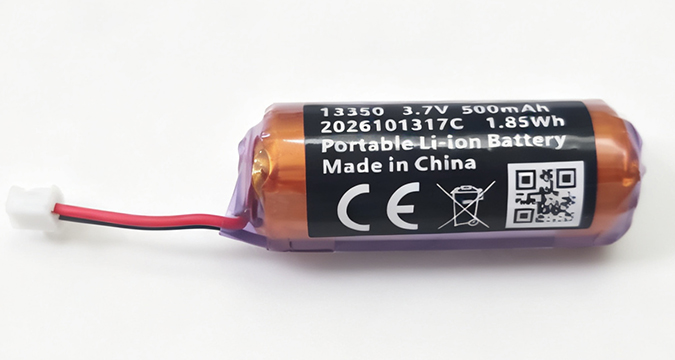
1.标签一般信息 | |
1.1制造商名称 | 惠州市凯业盛能源有限公司 |
1.2电池类型 | Battery Category |
1.3电池型号 | 13350 |
1.4生产地址 | 惠州市仲恺高新区陈江街道东江村委东楼村小组东翔公司厂房 |
1.5制造日期(年月) | 见喷码 |
1.6重量 | Approx. 10.2±1.5 g |
1.7容量 | 500mAh |
1.8电化学组成 | Lithium-ion LCO + NCM |
1.9有害物质(除镉铅汞外) | 1.3-propanesultone |
1.10可使用的灭火剂 | Fire extinguisher: Water-based extinguishing |
1.11浓度高于0.1%的关键原材料 | Cobalt,lithium,graphite,aluminium,copper, |
2.标签标识 | |
2.1垃圾桶标识 |
|
2.2 CE标志 |
|
3.1合格声明
EU Declaration of Conformity
Document No.: 13350-K.DD.T030
1. Manufacturer: Company Name: Huizhou Kaiyesheng Energy Co.,Ltd
2. Full Address: East Xiang Company factory, East Lou Village Group, Dongjiang Village Committee, Chenjiang Street, Zhongkai New District, Huizhou City
3. This declaration of conformity is issued under the sole responsibility of the manufacturer.
4. Object of declaration(产品描述 13350 锂离子圆柱电芯): Product: Lithium ion cylindrical cell Model: 13350 Nominal voltage: 3.7 V Nominal capacity: 500 mAh Intended use: Component for integration into electronic end products.
5. The object of the declaration described above is in conformity with the relevant Union harmonisation legislation:
· Directive 2014/35/EU (Low Voltage Directive, LVD)
· Directive 2014/30/EU (Electromagnetic Compatibility, EMC)
· Directive 2011/65/EU (RoHS 2.0), amended by (EU) 2015/863
Harmonised standards applied (supporting technical file TCF):
· EN IEC 62368 1:2020+A11:2020
· EN IEC 63000:2018 (RoHS assessment)
1. Notified Body: Not applicable (self declaration for component cell)
2. Additional notes: This cell is supplied as a component only. CE marking shall be affixed on the final end product, not on this bare cell. Supporting documents including cell specification, UN38.3 transport report, RoHS test report and technical construction file (TCF) are kept available for EU market surveillance authority upon request.
3. Signed for and on behalf of Manufacturer: Name: 
Place of issue: Huizhou City, Guangdong Province, China
Date of issue: 2026-10-15
3.2废电池预防和管理
Information on prevention and management of waste batteries
Information Document on Prevention and Management of Waste Portable Batteries
1 Role of End- Users in Battery Waste Prevention End- users can extend battery
service life through proper battery usage, thus reducing battery waste generation at source.
. Charge and use batteries in compliance with product instructions. Avoid improper operations including over- charging, high- temperature exposure, squeezing and over- discharging to maximise battery service life.
. Prioritise reuse, preparation for reuse, retrofitting for re- utilisation and remanufacturing of functional batteries to cut waste generation.
. Where battery performance is degraded yet the battery is not fully end- of- life, evaluate its secondary- use potential and avoid premature arbitrary discarding.
2 End- Users ’ Obligations for Separate Sorting and Collection of Waste Batteries Per obligations under Article 64 of the Regulation, waste portable batteries shall not be discarded mixed with household waste (EUR- Lex).
. Waste batteries must be separately sorted and collected and shall not be mixed with ordinary domestic waste.
. Once batteries reach end- of- life, deliver them to designated collection points for subsequent treatment by compliant organisations to recover high- value metals such as lithium, cobalt, nickel, copper and lead.
. All waste portable batteries, irrespective of brand, origin, condition or chemical composition, can be handed over to the official collection system free of charge.
3 Available Channels for Waste Battery Recovery, Take- back, Collection Points, Preparation for Reuse, Retrofitting and Treatment
1. Free take- back scheme: Waste portable batteries are taken back free of charge for end- users with no collection fees applied.
2. Collection channels: collection points at retail outlets, municipal waste collection sites, and collection bins deployed by Producer Responsibility Organisations (PROs).
3. Treatment route: Collected waste batteries are sent to compliant treatment facilities for preparation for reuse, retrofitting, disassembly and material recovery.
4. Waste batteries may be collected together with waste electrical and electronic equipment (WEEE) and end- of- life vehicles. Nevertheless, batteries shall be removed from such
equipment or vehicles afterwards for separate compliant battery treatment. 5. Portable battery collection targets:
. 31 December 2023: 45%
. 31 December 2027: 63%
. 31 December 2030: 73%
Forty- eight months after the Regulation enters into force, the EU may revise the collection targets in view of market conditions, technical advancement and
raw- material supply status.
4 Mandatory Safety Instructions for Waste Battery Handling (Including Hazards of Lithium- containing Portable Batteries)
1. Do not disassemble, puncture, drop- crush or incinerate waste portable lithium- ion batteries; internal short- circuit may trigger fire and deflagration risks.
2. Prevent positive- negative terminal short- circuit during waste- battery storage; tape may be used to cover battery electrode terminals.
3. If batteries swell or leak electrolyte, avoid bare- hand contact with electrolyte. Place the battery in a well- ventilated safe location and deliver it to a collection point promptly.
4. It is strictly prohibited to dispose of waste batteries in general waste bins, incinerators or sewer drains.
5. Avoid squeezing and impact during waste- battery handling and hand- over. Waste lithium- ion batteries carry thermal- runaway risks and shall not be stored in hermetically stacked piles.
5 Explanation of Battery Labels and Symbols Pursuant to Article 13 of the Regulation,
the meanings of symbols printed on battery bodies, outer packaging and accompanying documents are specified below:
. Crossed- out wheeled- bin symbol: signifies that the battery shall not be disposed of as ordinary household waste and must be separately sorted for recycling.
. Chemical marking: indicates key chemical constituents of batteries (lithium, nickel- cadmium, nickel- metal hydride, etc.).
. Markings for capacity, production date, manufacturer and registration number: Producers shall register with competent authorities of EU Member States and obtain a registration number; information linked to this registration number is traceable.
. Recycling and safety- warning pictograms: alert users to battery safety hazards and recycling- related legal obligations.
6 Impacts of Battery Constituents on Environment and Human Health; Hazards
Caused by Improper Disposal Portable batteries contain lithium, cobalt, nickel, lead and other hazardous substances:
1. In case of random discarding or disposal as unsorted municipal waste, broken battery casings will release heavy metals and toxic electrolyte that seep into soil and groundwater and cause soil- water environmental contamination.
2. Hazardous substances bioaccumulate through food chains and pose threats to flora, fauna and human health.
3. Lithium- ion batteries present fire hazards under landfill conditions; incineration will release toxic flue gas.
4. Proper separate collection and recycling allows high- value materials such as copper, cobalt, lithium, nickel and lead to re- enter the economic cycle and ease the pressure on primary mineral extraction.
7 Explanation on Extended Producer Responsibility Battery producers shall complete registration with designated competent authorities of EU Member States and obtain a registration number. Extended Producer Responsibility (EPR) covers: organisation of
waste- battery collection, transportation, reuse, remanufacturing, treatment and
recycling; reporting of data on batteries placed on the market; facilitating separate battery collection and bearing relevant costs; providing end- of- life battery- related information and covering all expenses incurred for fulfilling such obligations.
Enterprises shall establish supply- chain due- diligence mechanisms at the
raw- material procurement phase to mitigate labour- right risks in raw- material supply chains.
8 Compliance Statement This document satisfies all mandatory information
requirements under Article 74(a)- (f) of Regulation (EU) 2023/1542. It can be used as content for product manuals, webpages or QR- code- linked disclosure texts for
information disclosure to end- users and distributors serving the EU market.
Note: Each EU Member State shall transpose EU- level regulations into national
legislation. Actual implementation shall comply with local provisions of respective Member States.
Recommended Products
在
线
咨
询